
In 1453, the Ottoman Sultan Mehmed II — a 21-year-old ruler commanding the most powerful military empire of his era — faced a problem that should have been impossible to solve.
He was besieging Constantinople.
The city was the capital of the Byzantine Empire, the eastern remnant of Rome itself. It had stood for over a thousand years. It had repelled Arab armies, Viking raids, and multiple Ottoman sieges before Mehmed arrived. It had survived because of one geographic advantage that nobody had ever found a way around: the Golden Horn.
The Golden Horn is an inlet of the Bosphorus that cuts across the northern side of Constantinople’s walls. To attack those northern walls from the water, Mehmed’s fleet needed to enter the Golden Horn. But the Byzantines had stretched a massive iron chain across the entrance to the inlet. The chain was anchored on both sides of the water and sat just below the surface. No ship could break through it. No ship could pass it. The Ottoman fleet — dozens of warships, sitting fully armed in the Bosphorus — could not reach the northern walls.
Every military advisor told him the same thing. The chain is impenetrable. The inlet is blocked. Fight the walls you can reach. Find another way.
Mehmed did not argue. He simply asked a different question.
He did not ask how to break the chain. He asked how to go around it.
His engineers identified a hill — a ridge of land that separated the Bosphorus from the Golden Horn. They greased a road from the shore, up and over the hill, and down into the inlet on the other side. Then, over the course of a single night, Mehmed’s army dragged seventy-two fully equipped warships — masts, rigging, cannons, and all — up that hill and lowered them into the Golden Horn.
No chain stops a ship that never touches the water it was built to block.
When Byzantine defenders woke the next morning, the Ottoman fleet was already inside the Golden Horn. The northern walls were now under attack from the water. Constantinople fell within weeks. The last Roman Emperor died fighting in the streets. The city that had held for over a millennium was gone.
Now here is the part of the story nobody tells at the business launch party.
Mehmed did not win because he had better ships. He had the same ships he had the night before. He did not win because of a new weapon, a new technology, or a more sophisticated fleet. He won because he understood — with precise, unwavering clarity — exactly where his ships needed to be in order to win. He had direction before he had execution. He knew the harbour before he moved the fleet.
ChatGPT-5.5 just gave you seventy-two warships.
The most powerful content engine, image generator, reasoning model, and writing assistant in the history of small business is right now in your pocket, available for less than the cost of a sandwich. It can write your ads. Generate your images. Draft your email sequences. Build your landing pages. Produce your social content. Answer your customer’s questions. Summarise your competitor’s offer. Research your niche in minutes.
The question — the only question that determines whether any of that matters — is this: do you know where your Golden Horn is?
Because if you do not, you are about to spend serious time and real money dragging seventy-two ships in circles.
OpenAI released GPT-5.5. The internet did what it always does.
Launch videos. Breathless threads. “Here are 53 ways GPT-5.5 will change your business forever.” Within 24 hours, millions of entrepreneurs had updated their subscriptions, opened a new chat, and started generating. A post. An email. A product description. An image. A campaign.
Then they published it.
Then they waited.
Then nothing happened.
This is not a new experience. You had it with GPT-4. And GPT-4.5. And GPT-4o. Each time, the model was smarter. Each time, the content was cleaner. Each time, the results were the same: inconsistent, unpredictable, and exhausting.
Here is the truth nobody says out loud: the most widespread use of GPT-5.5 in its first week was generating captions for posts that performed exactly as well as the captions from GPT-4. More polished. Same silence.
The new image generation capabilities — genuinely impressive, genuinely faster, genuinely more detailed — were used primarily to create visually stunning content with zero customer context underneath it. No understanding of what the viewer is actually afraid of. No connection to what they privately want. No message calibrated to their real situation. Just something that looked good.
Looking good does not pay rent. It never does.
In 1960, Jerome McCarthy — an American marketing professor at Michigan State University — gave the world the 4Ps: Product, Price, Place, Promotion. For 1960, it was a reasonable map. The world had physical shelves, mass-market television, and a relatively simple media landscape. Distribution was the hard problem. Attention was free. Mass media reached mass audiences. The biggest challenge was getting the product in front of people.
That world ended. The 4Ps stayed.
And almost every piece of AI marketing advice being published today is still built on a framework designed for a Sears catalogue. It tells you to make a product, set a price, pick a place, and promote it. AI just helps you promote it faster.
But you are not struggling because promotion is too slow. You are struggling because you do not know, with precision, who you are promoting to — what they are actually afraid of, what they privately want, and what they already believe about businesses like yours before they read a single word of your content.
That is the wound. GPT-5.5 does not touch it.
That wound has a name. And naming it is the beginning of closing it.
The Execution Amplification Trap
There is a phenomenon I call the Execution Amplification Trap.
It works like this. A builder acquires a more powerful tool. The tool increases the speed and volume of their output. Whatever system they had before — good or broken — now runs faster and louder. If the system was good, the result is growth. If the system was broken, the result is faster, louder failure. More visible. More expensive. With better graphics.
The Execution Amplification Trap is not a metaphor. It is a mechanism.
McKinsey — the American management consulting firm that has tracked global AI adoption since 2017 — published its 2024 State of AI report with a finding that should have stopped every AI influencer mid-sentence. 72% of companies now use AI in at least one business function. Only 22% report measurable revenue impact directly attributable to AI. The engine is running. The car is not moving at all.
Why?
Because most entrepreneurs adopted AI the way they adopt every new tool: they asked “what can this do?” rather than “what does my customer actually need that I have not yet figured out how to give them?” Those are not the same question. They lead to completely different destinations.
The first question gives you capability without direction. A faster writer with no story to tell. An image generator producing visuals for a message nobody has understood. A chatbot answering questions about an offer that has not yet been calibrated to the customer’s real situation.
The second question gives you a map. And once you have the map, you can direct every tool you own — including GPT-5.5 — toward a destination that actually matters.
Stop Asking the Wrong Question
The dominant framework in every AI newsletter, podcast episode, and LinkedIn carousel right now is built on four words: “Use AI to grow.”
Upgrade those four words.
Stop asking: “How can AI help my business?”
Start asking: “Do I understand my customer well enough to tell AI what to build?”
That is not a subtle difference. That is the entire difference between a business that compounds and a business that produces impressive content while slowly running out of cash.
Alex Hormozi — the American entrepreneur who built a portfolio of businesses worth over $100 million, documented in his book $100M Offers — spent years proving a single point: the quality of the offer determines whether marketing works. Not the quality of the copywriter. Not the quality of the ad creative. Not the sophistication of the AI model. The offer. Meaning: how precisely does what you are selling map to what the customer actually wants to solve, have, and feel?
GPT-5.5 can write the most compelling version of a mediocre offer in the history of business. It will not fix the offer. That is your job. And your offer is not yet complete — not because you lack intelligence or drive — but because the work required to complete it is the work that almost no AI marketing advice tells you to do first.
That work is understanding your customer at a level that feels uncomfortable. Not their demographics. Not their general interests. The thing that wakes them at 2am. The aspiration they are too embarrassed to say out loud because it sounds too ambitious. The specific corner of the internet where they go when they are looking for someone who finally understands them. The belief they already hold about businesses like yours before they see your name.
That is the map. Without it, you are Mehmed’s warships in the Bosphorus. Powerful. Fully equipped. Aimed directly at the chain.
What Customer Ikigai Actually Does
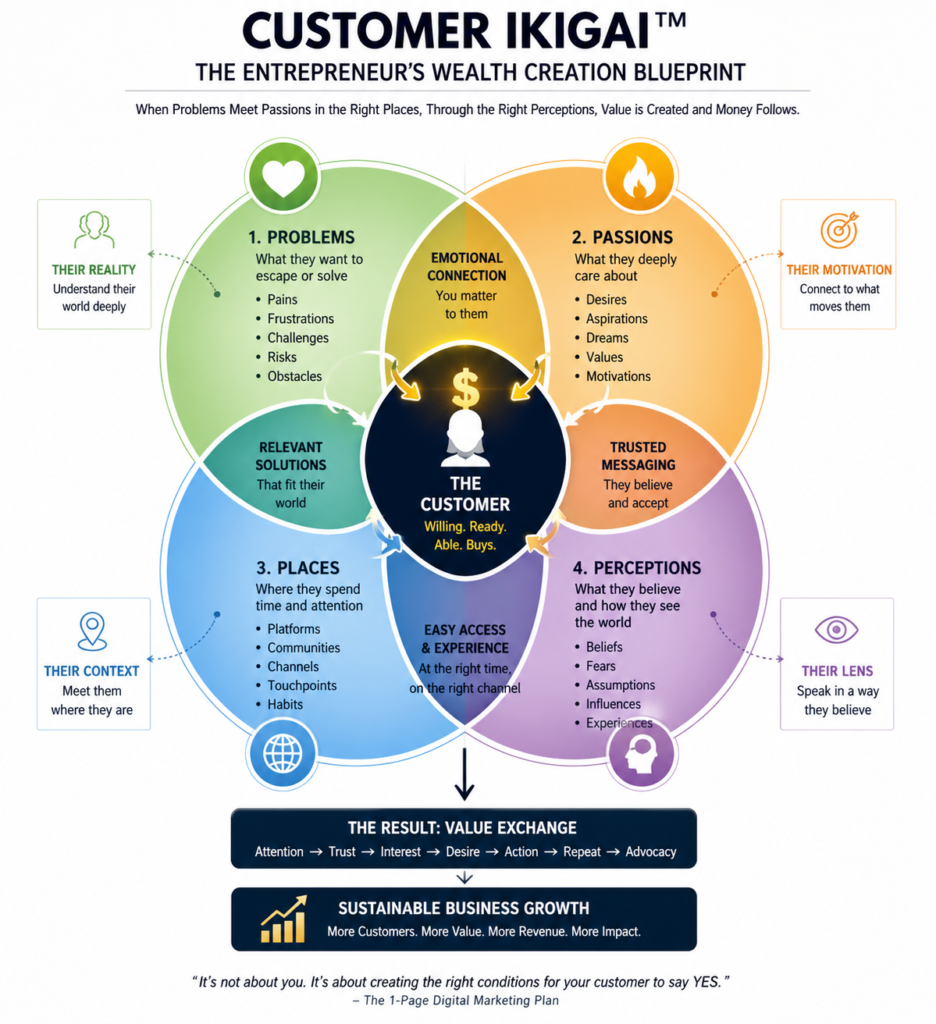
Customer Ikigai is the framework I built after a decade of building businesses across three continents — in Zimbabwe, in the United Kingdom, and across markets where the Western marketing playbook fails on contact with reality.
It maps four dimensions of the customer that determine whether your marketing converts.
Problems — not the problems your customer admits to in a survey, but the ones they cannot stop thinking about. Clayton Christensen — the Harvard Business School professor who developed Jobs to Be Done theory, arguably the most important advance in customer understanding since Maslow’s hierarchy of needs — argued that customers do not buy products. They hire them to do a specific job in their lives. The drill is not the product. The hole is. But guess what the hole is not the product either. The shelf the hole enables is. Guess what again, the shelf is not the product. The organised home and the feeling of calm it provides — that is the product. The emotional resolution is the product. The drill, the drill bit, the shelf, are all products hired to get to this emotional resolution. AI can only write copy that hits at that level if you have already done the work of going that deep. GPT-5.5 does not go that deep for you.
Passions — the obsessions that override the customer’s financial logic. The entrepreneur who says they cannot afford a $5 book will spend $5,000 on a coaching call from someone they admire online, because admiration bypasses the brain’s cost-assessment function entirely. Richard Thaler — the American behavioural economist who won the Nobel Prize in Economics in 2017 for his work on mental accounting — proved that humans do not treat all money as equal. They sort it into separate emotional accounts governed by completely different rules. Knowing which passion unlocks the right account is not something you guess. It is something you discover through the kind of customer research that most entrepreneurs skip because it feels slow. It is not slow. It is the only thing that makes everything else fast.
Places — where your customer already goes when they are looking for what you sell, before they know you exist. An entrepreneur in Lagos is not primarily on Pinterest or Goodreads. They are on WhatsApp Business groups, Nigerian’s Nairaland forums, and Facebook communities that no Western marketing textbook has acknowledged as a legitimate distribution channel. An entrepreneur in Nairobi is navigating Instagram and YouTube simultaneously, in Swahili and English, watching content from local creators who do not appear on any Western influencer list. A founder in Jakarta is asking business questions in Telegram channels and making purchasing decisions through Tokopedia. The Places dimension of Customer Ikigai is the one that renders most AI marketing advice irrelevant for the majority of the world’s entrepreneurs. Because the advice assumes Facebook ads and English-language SEO. That is not the world where hundreds of millions of businesses are actually being built.
Perceptions — what your customer already believes about businesses like yours before they see your name, read your headline, or hear your offer. Most entrepreneurs spend every marketing resource trying to convince. But the customer already has a verdict. It was formed before you showed up. It was shaped by the last bad experience, the last overpromised course, the last guru who talked about systems while his own business ran on his personal reputation. Your job is not to override that perception. You cannot override it with louder content. Your job is to acknowledge it, validate it honestly, and then redirect it with evidence. GPT-5.5 can execute that strategy with remarkable precision. But only if you know what the perception is. And most entrepreneurs never ask.
In Moneyball — the 2011 film directed by Bennett Miller, starring Brad Pitt as Billy Beane, the general manager of the Oakland Athletics baseball team — Beane does not win the season by acquiring better players. He wins because he changes what he measures. Traditional scouts measured speed, batting average, physical appearance, and gut feel. Beane and his analyst — played by Jonah Hill, drawing on the work of statistician Bill James — measured on-base percentage, because that was the number that actually determined whether a team scored runs. Everything else was noise.
The Oakland A’s had the same players they had the year before. The same stadium. The same budget, which was one of the smallest in Major League Baseball. What changed was the measurement. What changed was the direction.
GPT-5.5 gives you the fastest, most capable execution engine in the history of small business marketing. Customer Ikigai tells you what to do before you execute.
When you combine them — clear customer understanding directing a powerful AI engine — the Execution Amplification Trap becomes the Execution Amplification Advantage. You are no longer amplifying confusion. You are amplifying clarity. Every post carries weight. Every email is calibrated to a real problem. Every image is built with emotional context. Every ad targets a real person’s real desire using their own language reflected back at them.
That is not a minor improvement. That is the difference between the Bosphorus and the Golden Horn.
Here is what this essay has proven.
AI does not create strategy. YOU create the strategy. AI executes it.
GPT-5.5 lowered the cost of execution. It lowered the cost of confusion at exactly the same rate. The Execution Amplification Trap does not care how good the model is. It only responds to the quality of the direction you give it.
Every entrepreneur reading this sits in one of two positions right now.
The first position: clarity. You know your customer’s real problem — not the surface one, the 2am one. You know their passion, the one that overrides their logic. You know where they live online and what they already believe about businesses like yours. If that is you, GPT-5.5 is the most valuable tool you have ever been given. Use it without hesitation. Scale.
The second position is the more common one. You are generating content. You are using AI daily. You are posting, emailing, running ads, and experimenting with prompts. And something is still missing. Sales are inconsistent. Revenue does not follow a predictable curve. Attention converts to nothing you can point to. You are not doing anything wrong. You are doing everything without the map.
The Execution Amplification Trap ends the moment you do the customer work. Not the product work. The customer work.
Know the problem that wakes them at 2am. Know the passion that overrides their financial logic. Know the exact platform where they are searching right now for someone who finally understands them. Know the perception they carry before you say a single word.
Then open GPT-5.5. Then give it a direction. Watch what happens when a powerful engine finally has a driver.
OpenAI will release GPT-6. Then GPT-7. The engine will keep improving. But no model — not one, not ever — will understand your specific customer in your specific market better than you can, once you have the right framework.
Your business grows when your customer understanding grows. Not before.
Mehmed dragged seventy-two ships over a mountain because he knew exactly where the harbour was.
Do you?
If any of this landed, the full Customer Ikigai framework — the complete process for mapping your customer’s Problems, Passions, Places, and Perceptions — is inside The 1-Page Digital Marketing Plan. It is a short read, and you can work through the whole framework in a single sitting. Not another tool. A map. Visit 1-pagedigitalmarketingplan.com