One page. Four dimensions. The framework that makes your business immune to platform wars because it builds on the one thing no algorithm can take from you — your customer’s trust.
The pistol shrimp is a crustacean smaller than your thumb.
It kills by snapping one claw so fast it creates a cavitation bubble — a vacuum in the water that collapses in less than one millisecond and generates a shockwave, a temperature briefly HOTTER than the surface of the sun, and a sound louder than a gunshot.
The shrimp weighs less than five grams. Your smartphone weighs more. And yet, when that bubble collapses, the prey is already dead.
Scientists spent decades trying to understand how something so small could produce that kind of force. The answer, when it finally came in a landmark paper published in the journal Nature in the year 2000, reframed everything they thought they knew about power. The shrimp does not hit harder than its size allows. It does not fight the shark. It does not compete with creatures larger than itself. It simply understands one thing that larger animals do not: what you harness is more powerful than what you own.
The shrimp creates the conditions where physics does the hitting for it. The snap is just the initiator. The environment itself is the weapon.
Google just committed $40 billion to back Anthropic — the artificial intelligence company founded in 2021 by Dario and Daniela Amodei, two former senior researchers at OpenAI, the American company behind ChatGPT. That $40 billion is not a product launch. It is not a research grant. It is a land grab. Google is investing because it cannot afford to lose the attention economy — the invisible infrastructure through which every person on the internet discovers products, makes decisions, and spends money. And right now, that infrastructure is being rebuilt by companies with more money than most countries have in their annual budgets.
What that means for you is not abstract. It is happening in your analytics dashboard right now.
You have spent months building the right things. Maybe years. Creating content. Building your website or app. Learning how search engines work. Following the advice of people who told you the game was simple: produce good content, earn Google’s trust, receive traffic, convert customers.
That game is gone.
Google’s AI Overviews — the AI-generated answer panels that now appear at the top of search results before any website link — answer the user’s question inside Google. The user gets what they came for. Google keeps the user. Your website gets nothing. Research from SparkToro published in 2024 estimated that zero-click searches, where users get answers without ever visiting a website, now account for more than 60% of all Google searches.
More than half the people who searched for something you could solve today never left Google.
Never saw your content. Never reached your offer. Never had the chance to discover that you exist.
And with a $40 billion Google-Anthropic alliance now powering the AI models that generate those overviews, that 60% is not a ceiling. It is a floor.
So you did what every marketing podcast, every consultant, every LinkedIn post told you to do next. You turned to ads.
Here is the reality nobody prepared you for. You are not competing in that ad auction against other small businesses like yours. You are competing against venture-capital-backed startups with $50 million in runway who treat Google Ads as a fixed overhead cost. You are competing against global brands who can pay whatever it takes because marketing is a rounding error in their quarterly report. You are competing, in some categories, against Google and Meta themselves — both platforms advertise their own products in their own auctions, at their own prices.
That is not a competitive landscape. That is a trap.
And the customers on the other side of those ads? They are exhausted. They skip ads. They install ad blockers — global ad-blocker usage now exceeds 900 million devices worldwide. They scroll past sponsored content with the same absent muscle memory they use to bypass the cereal aisle in a supermarket. Before you spend a single dollar, your customer has already decided how they feel about ads. The verdict is not neutral. It is complete distrust.
So here is where you actually stand right now.
Organic traffic is disappearing from one direction. The cost and resistance of paid traffic is rising from the other. You are being squeezed from both sides simultaneously by forces that have $40 billion backing them and zero interest in whether your business survives.
There is an African proverb.
It is old enough that nobody knows exactly who said it first. It has been recorded in Swahili, Yoruba, Zulu, and a dozen other languages across the continent, and it means the same thing in every one of them.
When two elephants fight, it is the grass that suffers.
The elephants are Google and Anthropic. And Meta and OpenAI and Microsoft. They are fighting a war for AI dominance that will last years and cost hundreds of billions and reshape every digital surface that currently exists. They are fighting for the right to sit in the middle of every search, every feed, every recommendation — to own the layer between you and your customer.
And you — with your one product, your one team, your one idea that you know is genuinely good — are the grass.
But there is something the proverb does not say.
Grass does not die when elephants fight. It bends. It gets flattened. It looks, for a terrible stretch of time, like it is finished. And then — because grass is not trying to beat an elephant, it is simply trying to grow — it comes back. The same ground. The same roots. The elephants have moved on to the next battlefield. The grass is still there.
The question is not how to beat the elephants. The question is how to grow roots so deep that no platform war, no algorithm update, no $40 billion investment round can uproot you.
That is a Customer Ikigai question. And the answer does not require a billion dollars. It fits on one page.
The Platform Dependency Trap
Every entrepreneur who has ever built a strategy primarily on Google organic traffic, Facebook organic reach, Instagram Reels, or TikTok virality has experienced the same day at least once.
The platform changed the rules.
One algorithm update. One policy change. One new AI feature that intercepts a search query that used to send you fifty visitors a day. And the system you spent months building stopped working. Not gradually. Overnight.
This is not bad luck. This is what I call the Platform Dependency Trap — the moment a business’s growth becomes structurally dependent on a platform it does not own, cannot predict, and cannot compete with when it decides to change the terms.
The Platform Dependency Trap is not new. It has played out before.
In the early 2010s, Facebook business pages had organic reach above 16%. Post to an audience of 10,000 followers and more than 1,600 people saw it without spending a cent. By 2024, that number had collapsed below 2%. The same audience. The same effort. Facebook changed the rules and charged you to reach the people who had already chosen to follow you.
In 2018, Google algorithm updates destroyed thousands of businesses that had built their entire digital strategy around tactics the search engine had previously rewarded. Those businesses had done nothing wrong by the rules that existed at the time. The rules changed. The businesses did not survive the change.
AI Overviews is not a small tweak. It is the most structurally significant change to the search ecosystem in two decades. And a $40 billion Google-Anthropic partnership means the intelligence powering those overviews is about to become dramatically more capable, more comprehensive, and more confident in answering questions that used to send users to your website.
The Platform Dependency Trap now has a $40 billion engine.
There is one escape. But you will not find it in any AI marketing newsletter, because none of them are willing to say the thing that matters most.
Stop Fighting the Platform. Find Your Ground.
Here is the upgrade that changes everything.
Most entrepreneurs ask: “How do I get more traffic from the platforms that are taking my traffic?”
Start asking: “How do I build something that does not need the platform’s permission to grow?”
Those are not variations of the same question. They lead to entirely different destinations.
The first question produces a permanent, losing arms race — more content, more prompts, more optimisation, more ad spend, more dependency on the exact infrastructure that is squeezing you. The second question produces roots. Deep ones. The kind that survive algorithm updates because they are not built on algorithmic sand.
In The Big Short — the 2015 film directed by Adam McKay, starring Christian Bale as Michael Burry, a real-life hedge fund manager who diagnosed the collapse of the American housing market years before it happened — Burry does not win by fighting the banks. He does not protest the system. He does not try to change the algorithm. He wins because he reads the data that nobody else is willing to look at: the individual mortgage files, the specific human reality underneath the confident institutional model.
While every major bank in America was running the same spreadsheet and reaching the same confident conclusions, Burry was reading the actual loan documents. Who owed what. Whether they could pay it back. What the real situation was, underneath the version everyone preferred to believe.
The platform algorithm is the bank’s model. Customer Ikigai is the mortgage files.
What Customer Ikigai Actually Does
Customer Ikigai is the framework I built after a decade of working with businesses in markets where the Western marketing playbook arrives and immediately fails. In Zimbabwe, the infrastructure is unreliable. In Nigeria, the payment systems are different. In Kenya, the relationship dynamics are different. In Indonesia, the language and platform mix is different. And in every one of those markets, I found the same problem: entrepreneurs were using maps drawn for someone else’s territory.
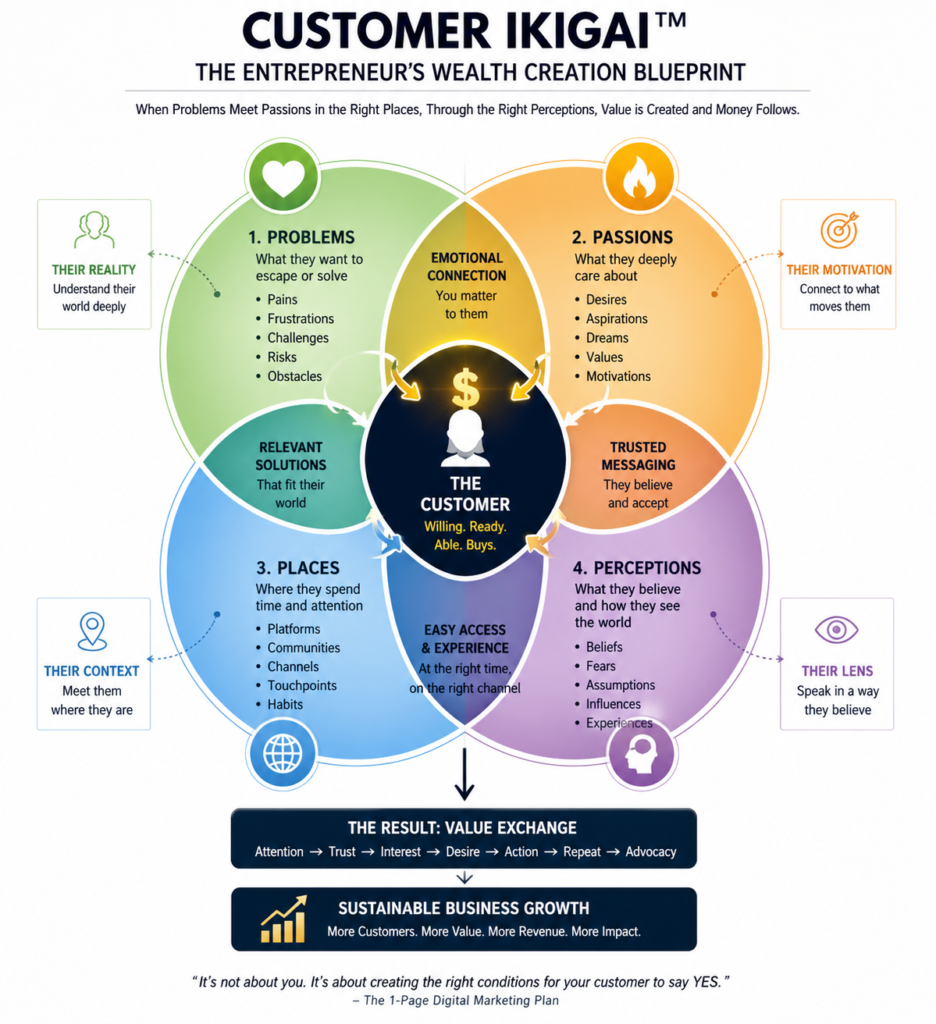
Customer Ikigai redraws the map around four forces that determine whether your marketing actually converts.
Problems — The 2am Truth
Not the problem your customer will state in a survey. The real one. The one that surfaces at 2am when the business has not grown this month the way it grew last month, and there is no explanation that makes the gap less frightening.
Clayton Christensen — the Harvard Business School professor whose Jobs to Be Done framework is the most practically useful advance in customer understanding since Maslow’s hierarchy of needs — argued that customers do not buy products. They hire them to solve a specific, emotionally urgent job in their lives. Until you can name that job with precision, your content — however well-written, however AI-polished — is aimed at a symptom rather than the wound.
The entrepreneur in Nairobi building a digital services business is not kept awake by “lack of traffic.” She is kept awake by unpredictable revenue. The inability to know whether next month will pay the school fees. The gap between the business she can see herself building and the business her bank account reflects. That is the job. That is what your marketing needs to solve. And GPT-5.5 cannot identify that job for you unless you have already done the work of going that deep.
Passions — What Makes Logic Break Down
Every customer you want has a passion so powerful it overrides their financial caution. Richard Thaler — the American behavioural economist who won the Nobel Prize in 2017 for his work on mental accounting — proved that humans do not treat all money as a single resource. They sort it into separate emotional accounts governed by completely different rules. The passion unlocks a specific account. If your marketing speaks to the passion directly, the financial logic reorganises around it.
The entrepreneur who wants to prove that a business built from Lagos can earn international respect does not want a marketing checklist. They want ammunition. They want the tool that makes success achievable from their context, without requiring them to translate every tactic from a San Francisco case study into a reality that looks nothing like San Francisco. That passion — to represent, to prove, to build something the doubters cannot explain away — is more powerful than any ad targeting parameter you have ever configured.
When your content speaks to that passion, it does not feel like marketing. It feels like someone finally got it. And the customer who feels understood does not need to be convinced. They are already leaning forward.
Places — The 60% Nobody Is Reaching
This is the dimension that the majority of Western marketing advice ignores entirely, and it is the dimension that matters most for the majority of the world’s entrepreneurs.
Your customer is not primarily on the platforms where conventional wisdom assumes they are.
An entrepreneur building a business in Harare is on WhatsApp. Not Mailchimp. A founder in Lagos is running her entire customer acquisition through WhatsApp broadcast lists, informal Facebook Groups, and Instagram DMs — not through SEO, not through Google Ads, not through the content strategy she read about in a book that used only American case studies. A business owner in Jakarta is making purchasing decisions through Tokopedia and Telegram channels that no Western marketing strategist has ever mapped.
The Places dimension of Customer Ikigai is not about platform demographics. It is about the specific, named corners of the internet and the offline world where your customer is already in conversation about the problem you solve. Go there. Become a detective. Listen. The language you find there — the exact words your customer uses when they think nobody with a marketing agenda is listening — is the only marketing language that converts at scale.
Because when you reflect that language back, you do not sound like a brand. You sound like someone who was in the room.
Perceptions — The Verdict That Arrived Before You Did
Your customer has already decided something about businesses like yours before you say a word.
That decision was shaped by bad experiences. The course that overpromised. The consultant who disappeared after the retainer cleared. The ad that made claims the product never delivered. The guru who built a six-figure business teaching six-figure business tactics to people who never made six figures.
The default perception your customer carries toward any new marketing message right now is not neutrality. It is suspicion. And here is why Google’s Anthropic investment makes this more acute: as AI-generated content floods every platform, every feed, every search result, the trust deficit deepens. Every piece of content now carries a quiet background question in the reader’s mind: is this real, or was this produced by a machine running a strategy I was never part of?
This is the intersection that defines the market in 2026.
You are losing organic traffic at the exact moment your customer has never been more distrustful of paid content. The platform squeeze and the trust deficit have arrived simultaneously. Two directions. One entrepreneur. Zero margin for confusion.
The Platform Dependency Trap squeezes from both sides at once.
The only thing that survives that double squeeze is a relationship built on genuine understanding. And relationships are not built by algorithms. They are built when your customer reads your message and thinks — not consciously, but in the fast, pre-conscious System 1 way that makes purchasing decisions — this person has been watching me.
That is what Customer Ikigai produces.
Not better content. A better understanding of the human on the other side. And in a world where Google is spending $40 billion to sit between you and your customer, that understanding is the only infrastructure that cannot be bought, disrupted, or algorithmically replaced.
The pistol shrimp does not fight the shark. It does not compete for resources it cannot win. It creates the conditions where physics does the work for it.
Your Customer Ikigai is your cavitation bubble. When you understand your customer with that precision — their 2am problem, the passion that overrides their logic, the exact corner of the internet where they are already searching, the perception they carry before you arrive — the shockwave travels on its own.
No $40 billion required.
The elephants will keep fighting.
Google will invest more. Meta will adjust the algorithm. OpenAI will release the next model. Anthropic will build faster. The money will keep flowing in directions decided in boardrooms that have never once thought about you, your product, or the customer you are trying to serve.
None of that has to matter.
Not because you can outspend them. You cannot. Not because you can beat the algorithm. You cannot. But because the game that will make you sustainable is not the game they are playing.
Their game: who controls the distribution layer?
Your game: who understands the customer deeply enough to convert attention into trust, and trust into revenue, regardless of which layer the distribution happens on?
Those are not the same competition. You do not need $40 billion to win the second one. You need one page.
Here is what the work actually looks like.
You stop looking for the next traffic hack. You stop asking which platform is growing and whether you should be on it. You sit with your customer — in their words, in their reviews, in the WhatsApp groups where they vent without performance, in the Reddit threads where they ask the questions they are too embarrassed to ask in public. You listen for the 2am problem. You find the passion that breaks through the financial logic. You map where they actually are, not where the marketing convention says they should be. You understand what they already believe about businesses like yours before you have said anything.
And then you build your plan on that foundation.
One page. Four dimensions. A system that works whether Google sends you traffic or not. Whether the ad auction prices you out or not. Whether the algorithm rewards your content or buries it.
Because your customer does not live inside an algorithm. They live inside a set of real problems, real passions, real places, and real perceptions. And the entrepreneur who maps those four things with precision becomes, for that customer, the only business that feels like it was made specifically for them.
The grass does not beat the elephants.
But the grass is still there when the elephants are gone. It was always going to be there. Not because it is stronger. Because it is rooted in something the elephants are not fighting over.
Be the grass.
Grow deeper roots.
Start with the page that gives you the map.
If this letter landed, the full Customer Ikigai framework — the complete process for mapping your customer’s Problems, Passions, Places, and Perceptions, and building a plan immune to platform changes — is inside The 1-Page Digital Marketing Plan. It is a short read, and you can work through the whole map in a single sitting. Not a course. Not a system that requires a team. A page. 1-pagedigitalmarketingplan.com