
The World Economic Forum estimated AI will displace 85 million jobs before 2026. Most of those displaced workers will attempt entrepreneurship. Most will fail at precisely the same moment — the day they realise a logo is not a brand.
The hermit crab is the only animal on Earth that never builds its own home.
It finds one — abandoned, vacated, shaped entirely by another creature’s body — and quietly moves in.
When that shell becomes too small, it does not build. It searches again. It finds one that fits slightly better and relocates. Then again. And again.
The hermit crab spends its entire existence inside a home it did not make, shaped to fit a body that was not its own, perpetually slightly uncomfortable because the fit is never quite right.
And here is what is extraordinary about this. The hermit crab is not weak. It is not unintelligent. It is one of the most adaptive, tenacious, and resourceful creatures in the ocean. It has survived conditions that have destroyed far larger animals. It is ancient. It has outlasted things that dwarfed it. By almost every biological measure, it is a success story.
But it has never, in its entire evolutionary history, built the one thing that would make it truly its own.
The shell it needs already exists somewhere out there. It just has to find the next one.
I am writing this to you because you are about to do the same thing — if you have not already started.
Meta announced another round of significant workforce reductions. Basically lay-offs. A lot of smart people are getting fired. So did Microsoft. These are not companies in trouble. Their revenues are growing. Their stock prices have recovered. The cuts are not distress signals. They are strategic ones. Both companies are re-allocating the cost of human labour into AI infrastructure — compute, models, systems — that can perform an expanding range of tasks at a fraction of the ongoing cost of a salaried employee.
This is the direction every large organisation is moving. Not some. Not a few pioneers. Every single one of them.
What that means for the people holding those jobs is not abstract. It is a letter, a meeting, a final paycheck, and a question they never expected to face quite this way: what do I do now?
The most common answer to that question, historically and increasingly, is some version of the same thing.
I will build something of my own.
The World Economic Forum’s projections suggested AI would displace over 85 million jobs while creating around 97 million new ones. The optimists read that and see a net positive. Bravo. All is well then. Not!
The honest reading is more complicated. The jobs being eliminated are administrative, repetitive, and entry-level — the exact roles that have provided starting points, training grounds, and income foundations for millions of workers who do not hold the technical skills required for the roles being created. Those workers do not vanish. They pivot.
And entrepreneurship is the most accessible pivot that exists. Perhaps the only one!
Which means you are about to be joined, in your market, by a wave of new entrepreneurs larger than anything the modern business landscape has previously seen. Some of them are talented. Many are motivated by a desperation that produces remarkable effort and some crazy ideas. Several of them are building something suspiciously similar to what you are building because thanks to AI, anyone can vibe code now.
And almost all of them are going to make the same first move.
They are going to design a logo for their business. Maybe using AI or Canva. But they will inevitably start with a logo.
Here is the invisible gap that no one explains clearly at the beginning of every entrepreneurship journey, and it is the gap that determines whether a business grows or remains permanently stuck.
When you work inside a company, even an average one — even one you were relieved to leave — you are separated from the most brutal reality of business by several layers of infrastructure that someone else built and that you never had to think about.
The company has a brand. That brand has equity. Customers recognise it. Some trust it. Others have a relationship with it that predates your arrival by years, sometimes decades. That brand is producing customers continuously, automatically, and without requiring you to do anything except show up and play your role inside the corporate machine.
You were one or two layers removed from the customer acquisition problem. You had a salary, a title, a framework, a sales team, a marketing department, or at least a CRM that someone had already populated. You were operating inside a running engine.
You just stepped out of that engine.
And the thing that nobody says plainly enough at the start is this: you did not step onto a neutral surface. You did not start at zero.
By deciding to become an Entrepreneur, you just started at minus fifty.
No trust. No recognition. No accumulated proof that you are worth buying from. No audience that has chosen to pay attention to you. No system that is generating customers while you sleep. And the instinct that almost every new entrepreneur follows — including the wave that is coming — is to close that gap by building the visible things first.
The logo. The colour palette. The website. The product photography. The business card. The Instagram bio. The X (twitter) handle.
None of those things are wrong. They are necessary. They are the foundation. You need them.
But a foundation is not a brand.
This is where the hermit crab problem begins. You move into a shell that looks, from the outside, exactly like a brand. It has the right shape. The right colours. The social media handle. The professional email signature. From the inside, it even feels like you are properly housed. Like you have arrived.
But a brand is not what you see when you look at your own business.
A brand is what your customer feels about you when you are not in the room.
And right now, when you leave the room, there is nothing there yet.
Apple does not introduce itself. Nike does not explain what it stands for every time it runs a marketing campaign. They have built something inside the customer’s mind that activates automatically at the sight of a logo, the sound of a name, a particular shade of colour on a product package. That activation — effortless, automatic, and self-perpetuating — is brand equity.
Brand equity is the ability to create a customer today, tomorrow, and six months from now without starting the relationship from scratch every single time.
You have none of it. Maybe less.
And the wave of newly displaced workers entering entrepreneurship this year, and next year, and the year after, are going to walk into exactly the same wall. Most of them will not understand why. They will diagnose it as a product problem. A pricing problem. A visibility problem. A platform problem. They will chase every solution except the right one because the right one is slow, invisible in the early stages, and requires a discipline that faster-looking alternatives make it easy to avoid.
It is a brand equity problem. And it has a system.
The most expensive misconception in entrepreneurship is that a brand is something you design.
It is not. A brand is something you build. Incrementally. Through content. Through consistency. Through a voice that belongs specifically to your business, shaped around your customer’s world, visible in the places your customer already inhabits, directed at the real problem your customer cannot stop thinking about.
Let me show you how this actually works, and why almost everyone gets it wrong.
Brand Equity Is Not a Budget. It Is a Behaviour.
Nike — the American sportswear company that now generates over $51 billion in annual revenue and is recognised in over 170 countries — did not become one of the most powerful brands on Earth by outspending its competitors.
It became that by understanding one thing about its customer that competitors consistently failed to understand.
Nike’s customer does not want shoes. Nike’s customer wants to be the version of themselves that exists on the other side of the race they were not sure they could finish. The identity they see in the mirror after completing something they were afraid to attempt. Nike does not sell footwear. It sells the permission to become a greater version of themselves.
“Just Do It” — three words first used in a 1988 Nike campaign created by the advertising agency Wieden+Kennedy — is not a product description. It is a direct line to the customer’s most private internal conversation: the one between who they currently are and who they know they could be. It does not describe the shoe. It describes the customer’s aspiration, named with the precision of someone who has been listening very carefully for a long time.
That is brand equity.
Not the slogan itself. What the slogan reflects: a deep, precise, almost uncomfortably accurate understanding of the customer’s inner world — their problem, their passion, their perception of themselves — translated into a voice that a stranger can encounter and feel, in a fraction of a second, was speaking specifically to them.
You cannot build that with a logo. You build it one piece of content at a time, over a sustained period, aimed with precision at the real human being on the other side.
The Brand Equity Deficit
When you left employment and entered entrepreneurship, you stepped off a moving escalator onto a stationary floor.
The escalator was the company’s brand equity. It was moving you toward customers, credibility, and trust without requiring you to generate any of that lift personally. The brand was doing it. You were simply standing on it, benefiting from the momentum someone else built.
The stationary floor is where every new entrepreneur begins. No lift. No movement. No momentum inherited from years of someone else’s investment. Everything you want to reach, you have to walk toward yourself. And walking from minus to zero — from invisible to technically existing — is the first journey. It is not the hard one.
Zero means you have a structure in place. If someone already knows your name and searches specifically for you, they find something credible. A website that loads. A social profile that looks considered. A product that can be evaluated.
Zero is not a customer. Zero is the right to be found by people who are already looking for you by name.
Brand equity begins above zero. Above zero is when a stranger — someone who has never heard of you, never searched for you, never been referred to you — encounters your content, your name, or your voice, and something shifts. Recognition begins. Familiarity starts to accumulate. The first layer of trust is laid.
Above zero is when word of mouth starts moving without you initiating it. When someone who has never met you tells someone who has never heard of you that you are worth paying attention to. When the content you produced three months ago is still being shared by people you have never spoken to.
That movement — from zero to above zero — has exactly one engine in 2026.
Content.
Content Is What Builds Brand Equity
This is the insight that most entrepreneurs encounter, nod at, and then immediately translate into posting. Posting is not content. Posting is what happens when you have content. Content is the act of giving your brand or business a voice — a specific, consistent voice shaped around your customer’s real world, aimed at their real problem, expressed in their own language.
Daniel Kahneman — the Israeli-American psychologist who won the Nobel Prize in Economics in 2002 and whose book Thinking, Fast and Slow has sold over ten million copies worldwide — discovered that the human brain evaluates familiarity before it evaluates competence. Before your customer decides whether you are good at what you do, their brain makes a prior, faster, largely unconscious decision: does this person feel familiar enough to warrant further attention?
Familiarity is not built in a single encounter. It is built through repeated, consistent exposure over time. And repeated exposure is the one thing that directed, strategic content produces.
Apple did not create a global culture of iPhone desire through a single advertisement. It compounded. Packaging, keynote presentations, retail store design, advertising campaigns, product naming, software language — every touchpoint calibrated around the same precise customer understanding for decades. The result is a brand that arrives at the purchase decision pre-trusted. The customer does not need to be convinced. The brand equity has already done the closing.
You are building the same thing. Just faster. And the tool that compresses Apple’s decade of billion-dollar consistency into something one entrepreneur can build alone is the combination of the internet and a system that tells you exactly what to say, to whom, in which places, and for what reason.
That system is Customer Ikigai.
The Customer Ikigai Framework
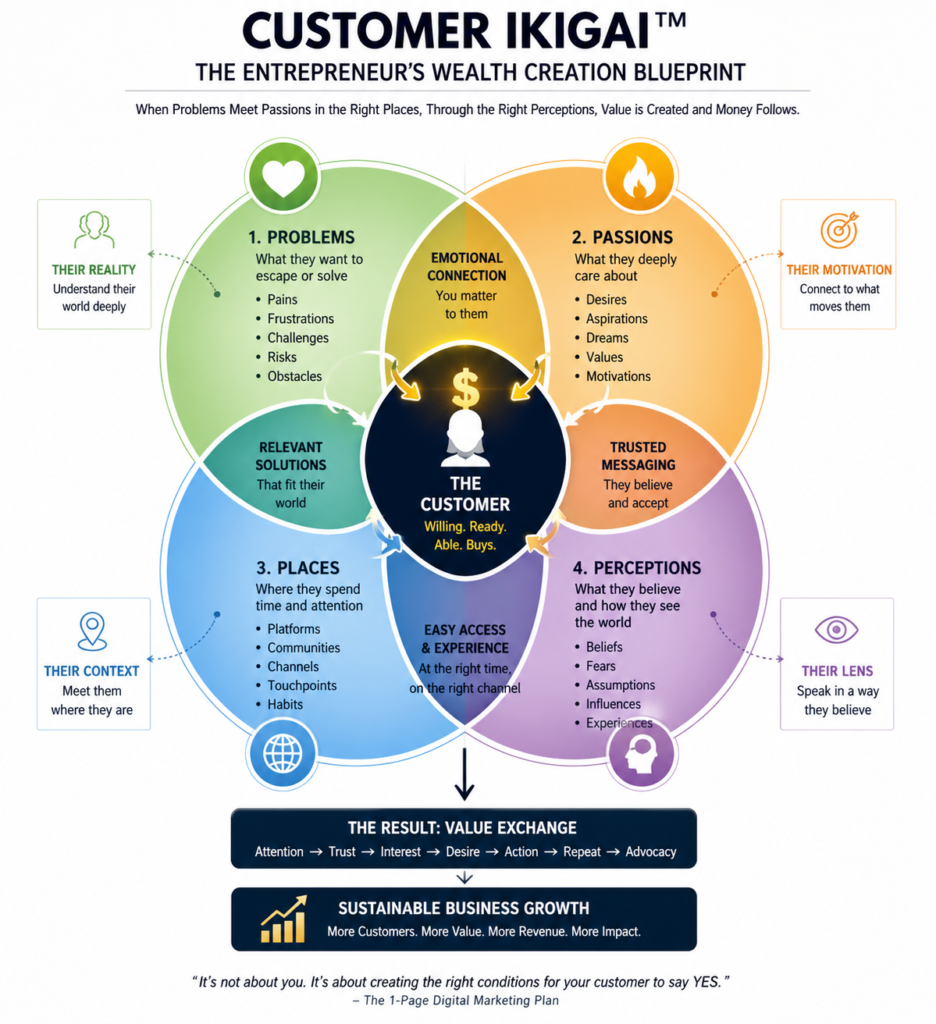
Customer Ikigai maps the four forces that determine whether your content builds brand equity or dissolves into the noise.
Problems
Not the surface problem. The real one. The one your customer cannot articulate cleanly in a survey because it is too close, too frightening, and too entangled with their identity to name out loud.
Clayton Christensen — the Harvard Business School professor who developed Jobs to Be Done theory, one of the most practically useful frameworks in the history of customer understanding — argued that customers do not buy products. They hire them to resolve a specific, emotionally urgent job in their lives. The drill is hired to make the hole. The hole is hired to anchor the shelf. The shelf is hired to create the organised home. The organised home is hired to produce the feeling of peace, control, and competence that the customer has been privately craving since the last time they walked into a room that felt like chaos.
When you know the real job — not the product-level job, but the emotional-resolution job — your content stops feeling like marketing. It starts feeling like the customer is reading their own internal monologue back to themselves.
An entrepreneur in Lagos building a consulting practice does not have a “visibility problem.” She has a credibility-with-strangers problem — the gap between how good she knows she is and how much proof exists in the world that her specific kind of client can trust. Content that names that gap with precision builds brand equity with every person who reads it and recognises themselves in the description.
Passions — What Makes Logic Break Down
Every customer has a passion so powerful it overrides their cost-assessment function. Richard Thaler — the American behavioural economist who won the Nobel Prize in Economics in 2017 for his work on mental accounting — proved that humans do not treat all money as a single, rational resource. They categorise it into separate emotional accounts, each governed by different rules, each accessed by different keys.
The passion is the key. When your content speaks to the passion directly — the aspiration beneath the aspiration, the identity statement the purchasing decision makes — it opens an emotional account that rational pricing cannot close.
The entrepreneur who privately wants to prove that a business built from Nairobi can earn international clients and international respect is not buying a marketing book. They are buying ammunition. They are buying the framework that makes international credibility achievable from their actual context. That desire is stronger than price. Content that speaks to it builds brand equity that no competitor can replicate, because that competitor has not done the work of listening closely enough to know the desire exists.
Places — Where Your Customer Already Lives on the Internet
Your customer is not primarily on the platform you prefer. They are on the platform that belongs to their context, their culture, and their specific daily rhythm.
An entrepreneur building a business in Harare is on WhatsApp before she is on LinkedIn. A founder in Lagos is running her entire customer relationship through WhatsApp broadcasts, informal Facebook Groups, and Instagram DMs — not through the SEO-driven content strategy she read about in a book that used only San Francisco case studies. A business owner in Jakarta is making purchasing decisions through Tokopedia and Telegram channels that no Western marketing textbook has ever mapped as a legitimate distribution channel.
Content distributed in the wrong places does not just underperform. It is invisible to the person you are trying to reach. The Places dimension of Customer Ikigai tells you not which platforms are growing, but which specific corners of the digital world your actual customer inhabits — and what language they use when they think no one with a marketing agenda is listening.
That language — the exact words your customer uses to describe their own problem before they have been given a framework to describe it — is the only marketing language that builds brand equity at scale. Because when you reflect it back, you sound like someone who was already in the room.
Perceptions — The Verdict That Arrived Before You Did
Your customer has already decided something about businesses like yours before you say a word.
The course that overpromised. The consultant who disappeared after the deposit. The guru who sold the dream while running a business that depended entirely on selling the dream. The advertisement that claimed transformation and delivered a PDF. The brand equity of distrust has been built by every bad actor who preceded you in your industry.
Your content either acknowledges that perception honestly and dismantles it with evidence — not promises, evidence — or it triggers the scepticism filter and gets scrolled past before the second sentence.
The specific is believed. The general is distrusted. One client result, named precisely, with a number and a context, builds more brand equity than a hundred testimonials that say “this was great.” Because precision signals reality. And reality, in a world flooded with AI-generated content and algorithmically optimised promises, is the rarest and most valuable signal your brand can emit.
From Zero to Above Zero
The journey from minus to zero to compounding brand equity is not linear and it is not fast. It does not reward effort applied in bursts. It rewards consistency applied with direction.
Here is the genuinely good news inside a market flooded with new competition.
The majority of the new entrepreneurs entering your market over the next two years will post randomly. They will copy trends. They will chase the algorithm. They will try to please Miss Attention. They will build their logo, wait for the brand to materialise, and stop when it does not arrive on schedule.
The compounding effect of content — the inflection point where brand equity begins to self-generate new exposure without proportional new effort — typically does not arrive until somewhere between nine and twelve months of consistent, directed output. Most content creators and business accounts stop within three to six months.
They quit at exactly the moment before the compound begins.
The entrepreneurs who understand this, and persist through the silence before the inflection, enter a space where the majority of their competition has already vacated.
Meta and Microsoft did not cut those jobs because those people failed.
They cut them because AI made the roles cheaper to fill with systems than with humans. That is not a moral judgment on the people. It is an economic one about the roles.
But the people are now entering your market. And they are going to make the same move that every new entrepreneur makes.
They are going to build the logo and wait for the customers.
You have a different move available.
Build the brand equity that the logo cannot build. Show up consistently. Use your customer’s actual language. Publish in the places they actually inhabit. Name the problem with surgical precision. Speak to the passion that overrides their logic. Acknowledge the perception they carry before you arrive. Give every piece of content one job: move one specific human being one step closer to trusting you.
Do that for twelve months without stopping.
The hermit crab spends its entire life in shells that never quite fit. They are always a little wrong. They are always borrowed. The fit is always slightly off because the shell was shaped by someone else’s body.
You are not building someone else’s shell.
You are building yours. One piece of content at a time. In your specific voice. In your customer’s exact language. In the places they already live.
AI will make it easier to start. It will not make it easier to build the thing that actually creates customers — the trust, the familiarity, the accumulated proof that you understand the person on the other side of the screen better than any competitor does.
That is still human work. Your work.
The safest entrepreneur in 2026 is not the one with the most AI tools. It is the one whose customer encounters their content and thinks — without being persuaded, without being targeted, without being sold to — this person gets me.
Start building that.
The brand follows the work. It always has.
If this landed, the full system — Customer Ikigai, the content framework that builds brand equity, and the one-page marketing plan that ties it all together — is inside The 1-Page Digital Marketing Plan. It is a short read, and you can work through the whole thing in a single sitting. Not a course. A map. 1-pagedigitalmarketingplan.com