In the 1992 Barcelona Olympics, a British sprinter named Derek Redmond was running the 400-metre semi-final. He had trained for this race for many years – since Olympics only come around once every 4-years! He had overcome serious injuries, surgeries, and setbacks that would have ended most careers. He had earned his lane. When the gun fired, he ran beautifully — his stride long, his form clean, his years of sacrifice suddenly visible in every metre.
Then, 250 metres from the finish line, his hamstring snapped. When you tear your hamstring, you know this because you get a sudden, sharp, and intense pain in the back of the thigh, often accompanied by a distinct “pop” or tearing sensation. It’s brutal.
He went down. Of course he had to. The medics on the track quickly came. To their surprise, he waved them off. Then something happened that nobody in that stadium was prepared for. He stood up. He started hobbling toward the finish line, one leg collapsing with every step, his face absolutely destroyed by pain, weeping openly in front of sixty-five thousand people and a global television audience. His father, standing anxiously and watching it all, couldn’t just stand there, he broke through the security barriers and ran to him. Put his arm around him. They crossed the finish line together — not in first, not in the medals, not in the record books. Just finished the race.
The crowd gave him a standing ovation that shook the whole stadium and those watching at home.
I am starting here because I want to be honest with you before we talk about making money. The kind of honesty that most “how to make a million dollars” TikToks and Reels are scared to tell you.
Building a business, becoming an Entrepreneur is literally being like Derek Redmond at 250 metres from the finish line. It is the moment when everything you trained for starts to collapse in public, when the medics (a job) are offering you an exit, and the only thing separating the person who finishes from the person who does not is a decision made in the most private part of the self — a decision that nobody else can make, that no course can prepare you for, and that no amount of motivational content will sustain when the actual moment arrives.
I need you to understand this before anything else. Not to frighten you. Because the ones who quit usually do so not because the business was impossible, but because nobody told them how hard and lonely it is. They thought the pain was a sign they were doing it wrong. It was a sign they were doing it at all.
Now let me tell you about the world you are entering.
Citigroup’s research found that AI could displace up to 54% of banking jobs. Goldman Sachs placed the global figure at 300 million jobs across industries. And now, in 2026, Citrini’s Research has published work pointing toward what analysts are calling the Great Intelligence Crisis: a world where AI agents do not merely assist white-collar workers but systematically replace them, layer by layer, from junior analyst to middle manager, until the organisational structures that employed tens of millions of educated, capable, ambitious people have been rebuilt around machines that do not sleep, do not ask for raises, and do not need pension plans.
The people who held those jobs are now looking for somewhere to go.
The most accessible door they can find — the one that requires no interview, no approval, no institutional gatekeeping — is entrepreneurship.
So they walk through it. And they arrive at the place where you already are.
Here is what nobody tells them — what nobody is telling you, either, with enough directness to actually land — about the difference between the world they just left and the one they just entered.
Inside a company, even an average one, there is a force working invisibly on their behalf every single day. It is not the salary, though the salary matters. It is not the colleagues, though the colleagues help. It is something that cannot be replicated quickly, cannot be purchased from a designer on Fiverr, and cannot be manufactured by having a consistent Instagram aesthetic.
It is the brand. Brand equity to be precise.
Apple does not wake up every morning wondering how to get customers. Apple’s brand does that. It operates continuously, automatically, in the minds of hundreds of millions of people around the world, producing purchase intent that arrives before Apple has said a word. The Apple iPhone’s next model will be queued for before it is announced, reviewed by MKBHD and others way before it is released to the general public, and desired by people who cannot yet tell you what is different about it compared to the previous generation. That desire was not generated by a marketing campaign this morning. It was accumulated across decades of consistent presence, consistent quality, and consistent delivery of an experience that made people feel a specific way about themselves when they held the product.
That is brand equity. It is the most powerful customer-creation force in the history of business.
When you left your job, or when you started this business, you lost access to someone else’s brand equity. You stepped off the moving escalator that was carrying you toward customers and credibility without requiring you to generate any of that lift personally. You stepped onto a stationary floor.
You do not start at zero. You start at minus.
No trust. No recognition. No accumulated proof that you are worth buying from. No system running in the background generating customers while you sleep. The logo that ChatGPT or Nano Banana Pro made you or a Freelancer on Upwork/Fiverr made you is not a brand. The website is not a brand. The social media profile with the consistent aesthetic and the carefully written bio is not a brand. Those are the components of a foundation. And a foundation is not a house. You cannot live in it. Your customers cannot find you in it. And the rain comes through.
This is the hardest part of entrepreneurship. Not the long hours. Not the uncertainty. Not the loneliness of making decisions at midnight with no one to consult and everything at stake. The hardest part is the sustained invisibility of the early days, months, even years — the period when you are working harder than you have ever worked and the market is responding with silence.
Most people interpret that silence as failure. They stop. They quit, silently and suffer loudly. They become statistics in someone’s essay about why entrepreneurship is hard.
The ones who stay — the ones who understand that the silence is not a verdict but a phase, that brand equity is accumulated slowly and then suddenly, that the customer-creation system they are building is an asset that compounds — those are the ones who cross the finish line.
But they need a map to get through the silence. Because suffering without direction is just suffering.
The Truth Most People Avoid
Let us start with what is true and will always be true.
A business has only two functions. To innovate and to create a customer. Everything else is noise. Not the logo. Not the brand colours. Not the social media follower count. Not the beautifully formatted content calendar with the colour-coded categories. Not the Notion dashboard you rebuilt three times to feel more organised.
If you are not building something different and turning strangers into customers, you do not have a business. You have a hobby. And hobbies are wonderful, but hobbies do not make you a million dollars.
Peter Drucker said it in 1954. Nobody has improved on it since. The purpose of business is to create a customer. Two functions make that happen — innovation and marketing. Everything else is overhead. Most entrepreneurs spend the majority of their working week on the overhead and get surprised when they are not making any progress.
The Brutal Mathematics of a Million Dollars
If you want to make $1 million in 2026, your chances depend on exactly three variables. Skills, time, and money. That is it. Everything else — your idea, your passion, your vision board, your affirmations, and motivational playlist on YouTube — either operate inside those three constraints or don’t at all.
Let us be honest about each one.
If you have money, you better have a lot of it. At least to help you start on the right foot.
Money replaces skills because you can hire the people who have them. It replaces time because you can compress timelines by paying people or using AI (and software) to run in parallel. If building an app, you will need real developers — not vibe coders. Real marketers — not people who are still figuring out what a conversion rate is and are vibe marketers. Real operators who have run systems before.
And here is the truth about vibe coding while we are on the subject: it is not a skill. It is a capability, and it is a useful one — but only if you already understand how systems are built, if you have been in the trenches and know what good output looks like and what broken code feels like before it breaks in production. Without that foundation, you will burn money fast and possibly get hacked. You will not know what you are looking at until it stops working at 11pm on a Thursday when you have customers waiting.
If you have no money, you better have some good skills and time. You will learn, build, test, fail, and iterate. You will be the founder and the developer and the marketer and the salesperson and the support function and the operations team simultaneously. This is the hardest path. It also takes the longest. It is also the path that most serious entrepreneurs who eventually succeed have walked, because the pressure of no safety net creates a quality of attention that money occasionally buys people out of too early.
If you have no money and no skills, your only resource is time. And the way most people spend that time — watching YouTube channels about becoming a millionaire, consuming TikTok content about passive income, paying $997 (that you don’t have) for courses promising six figures in sixty days — is the most reliable way to spend a year making no meaningful progress. Your odds are low. Very low. Not because you lack intelligence. Because you lack leverage, and leverage is what converts effort into scale. But you can use your time wisely, learning the skills that matter, coding and marketing, and using them to earn some money to help you get started.
Now the number nobody wants to hear. A million dollars in revenue means you gave a million dollars’ worth of value in exchange. Not in your opinion. In your customer’s. The market is the only judge that matters, and the market does not grade on effort or intention. It grades on value delivered.
You can either sell products and accumulate a million dollars in sales, or offer a service and accumulate a million dollars in service contracts. Both paths work. Both have their honest limitations.
Physical products require capital for inventory. If you are tempted by drop-shipping — the business model where you sell products you do not hold in inventory, dispatched from a supplier you do not have any control over — think carefully. Margins are thin. Competition is brutal. And you end up buying courses to learn how to do it, and still get nowhere with it. You are competing on price against suppliers who can undercut you without consequences because the product is theirs. Drop-shipping can generate revenue. It almost never generates the profit margins that create financial freedom. But the people who teach drop-shipping, they gain financial freedom from selling the picks and shovels to becoming rich through drop-shipping though!
Digital products change the equation. Time, skills, and some money can create something sold a thousand times without a marginal cost increase. But creation and distribution still require the thinking that most people skip, which is the same thinking that makes every other business model work.
Services are easier to start and harder to scale. You either start solo or hire people — which introduces management, overhead, and the particular complexity of running a team before the revenue justifies it — or you use AI, specifically AI agents, which in 2026, AI agents can handle logical, repeatable work at extraordinary volume. The limitation is that genuinely creative, judgment-intensive service work still requires human intelligence directing the machine. And also they are not good at physical work, even though we have AI-powered robots. AI agents are extraordinary at executing a strategy. They cannot yet generate the strategy worth executing.
The 2026 rule is simple. If you are not AI-first, you are competing against someone who is doing the same work faster, cheaper, and at greater volume. Use AI for content, research, operational systems, and anything where one plus one equals two. Keep it human for the creative judgment, the strategic insight, the understanding of the customer’s interior life that no language model trained on the average of all the internet can replicate.
And the most important thing: you do not become a millionaire with a me-too product or a me-too service. You do not get there by being louder. You get there by being different — genuinely, structurally different in a way that your specific customer recognises as the solution they could not find anywhere else on the internet or in their town.
Not different for the sake of it. Different in a way that solves a real problem better than anything else that currently exists for the specific customer you are serving.
That is innovation. And it is the first of Drucker’s two functions for a reason.
The Real Example That Makes All of This Concrete
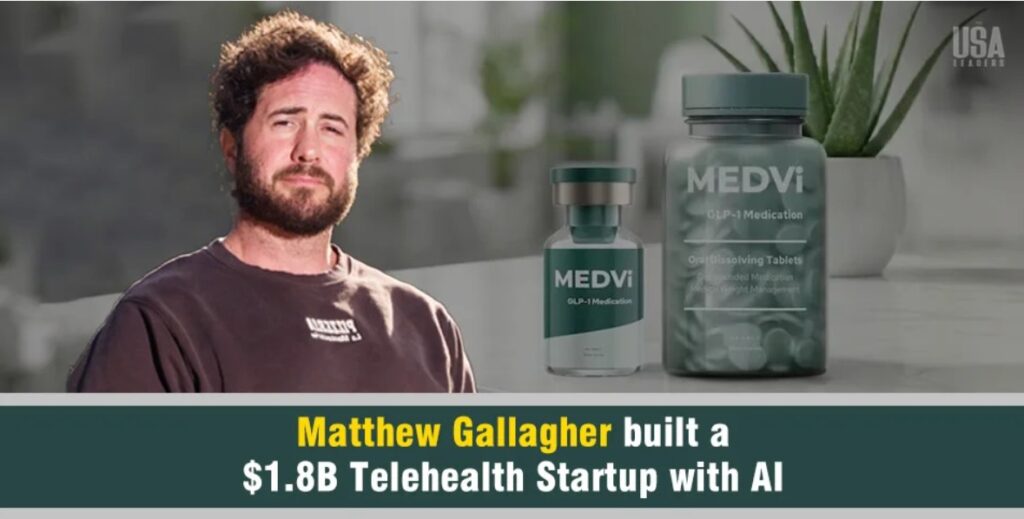
Matthew Gallagher is forty-one years old. He lives in Los Angeles. In September 2024, he started a company called Medvi with $20,000 and his brother. No office. No venture capital. No marketing agency. No team of engineers in a glass building with a ping-pong table.
Forbes and the New York Times covered what happened next.
By the end of the first month, Medvi had 300 customers. By the end of the second month, 1,000. By the end of 2025 — his first complete calendar year — Medvi had generated $401 million in revenue, served 250,000 customers, and produced $65 million in net profit. Sixteen-point-two percent margins. Two employees!!!!!!
This year, Medvi is on track for $1.8 billion in 2026. Sam Altman reportedly won a bet about whether a one-person company could reach a billion dollars in revenue. He won it because of Gallagher.
Medvi sells telehealth services for GLP-1 weight-loss medications. GLP-1 drugs — Ozempic, Wegovy, and compounded alternatives — have created one of the largest consumer health waves in a generation. The global market is valued at $94 billion and projected to reach $216 billion by 2035. Gallagher did not invent GLP-1. He did not invent telehealth. He identified a gap between what customers desperately wanted — fast, private, affordable access to effective weight-loss medication — and what the existing market was delivering. Traditional healthcare required appointments that felt shameful for a stigmatised condition. Existing telehealth providers were slow. Compounded alternatives were available but under-distributed and under-trusted.
He built the bridge between the demand and the supply. He built it with ChatGPT, Claude, and custom AI agents handling coding, copywriting, and operational workflows. He directed the thinking. The machines scaled the execution.
This is not an AI company. It is a telehealth company that used AI with the intelligence of someone who understood the customer before he touched the tools. And very soon, as AI agents grow more capable of managing entire operational workflows autonomously, we will see the first true one-person billion-dollar company — not two people, one — because the tools are almost there. What has always been there, unchanged and irreplaceable, is the thinking that directs those tools.
Gallagher did the thinking. Let me show you what that thinking looks like in practice.
The Internet Has Changed the Game
Your market is no longer a physical location. It is not a UK high street. It is not a postcode/zipcode. It is not a region or a country or a demographic segment.
Your market is on the internet.
On a phone. Available at 3am on a Tuesday when something has gone wrong and someone is searching for the solution you sell.
The word marketing comes from the idea of going to the market — the physical place where buyers and sellers gathered. You went there. You set up your stall. You called out to people passing.
That world is gone.
The market no longer waits in one place. It is distributed across hundreds of surfaces, searching and scrolling and consuming simultaneously, moving between platforms in milliseconds.
Now the market comes to you. But only if you know how to get its attention. And only if you have built the system to convert that attention into money before it moves on to the next thing.
Think of the internet like a casino. You do not walk in and win money instantly. You buy chips first. You learn the game. You play the game. You accumulate chips over time. Then you cash them in.
On the internet, attention is the poker chip.
Attention is the currency that precedes every other currency. The money before the real money. Without it, you are not even at the table. With it, every other function of the business — conversion, retention, referral, revenue — becomes possible. No attention means no game. It does not matter how good the product is. It does not matter how competitive the pricing is. It does not matter how extraordinary your customer service is. If no one is paying attention, the business is invisible. And the best business in the world, invisible on the internet, is just a hobby that makes no money.
The old model worked like this. You built the product. You marketed it. You made money. Clean. Sequential. Predictable. The new model is more complicated and less forgiving. You get attention first. You build trust with that attention over time. Then — only then, after the trust has been accumulated — you convert it into money. Attention to trust to conversion to sales. And the attention phase takes longer than anyone wants it to, and costs more than anyone budgets for, and produces less visible short-term return than anything else in the business.
This is why most entrepreneurs give up too early. They are in the attention phase — the poker chip-accumulation phase — and because the chips do not yet look like revenue, they conclude the game is not working and walk away from the table.
The game was working. They just did not understand which phase they were in.
Most people, when they understand the attention problem, say the same thing: I need to create content. And they are not wrong. But they are dangerously incomplete. Because they immediately translate “create content” into “try to go viral.” And trying to go viral is the business equivalent of standing outside with a camera trying to photograph a shooting star. The stars exist. They will appear at some point. You might even capture one, once, by accident or by extraordinary skill or by the specific alignment of audience, platform, timing, and message that cannot be engineered on demand. (I wrote about this in the essay, Miss Attention)
But a shooting star is not a strategy. You cannot build a business on events that happen once by accident.
You need a system. Not viral. A system. A system that gets attention every day, that turns that attention into trust over time, and that converts trust into customers on a predictable basis — not the day something happens to perform well, but every day, as a function of the architecture you have built.
This is where most people fail. Not because they lack talent, or drive, or a genuine product. Because they have tactics — posting schedules, content pillars, platform strategies — but they do not have a system. They are doing things. They are not building anything.
The Marketing System
I have worked with hundreds of entrepreneurs across multiple industries and geographies. I have watched talented people with excellent products fail because they did not have this. I have watched people with ordinary products succeed dramatically because they did. If I genuinely believed there was a better framework for customer creation on the internet, I would tell you here, without hesitation, because this essay is about your business, not mine. But these are the frameworks I have tested, refined, and seen work under real pressure with real money at stake. They are the reason this essay exists. They fit on one page. They are yours.
The book is called The 1-Page Digital Marketing Plan. What follows is the system inside it.
Step One: Customer Ikigai — before a single word of content is written.
This is the step almost everyone skips. And it is the precise reason that most content never creates customers. It is slow. It does not produce anything that looks like progress for the first few days. It requires sitting with discomfort and research instead of creating things that feel productive. That is exactly why it works — because everyone else is skipping it, and the entrepreneur that completes it has an advantage that no money can buy.
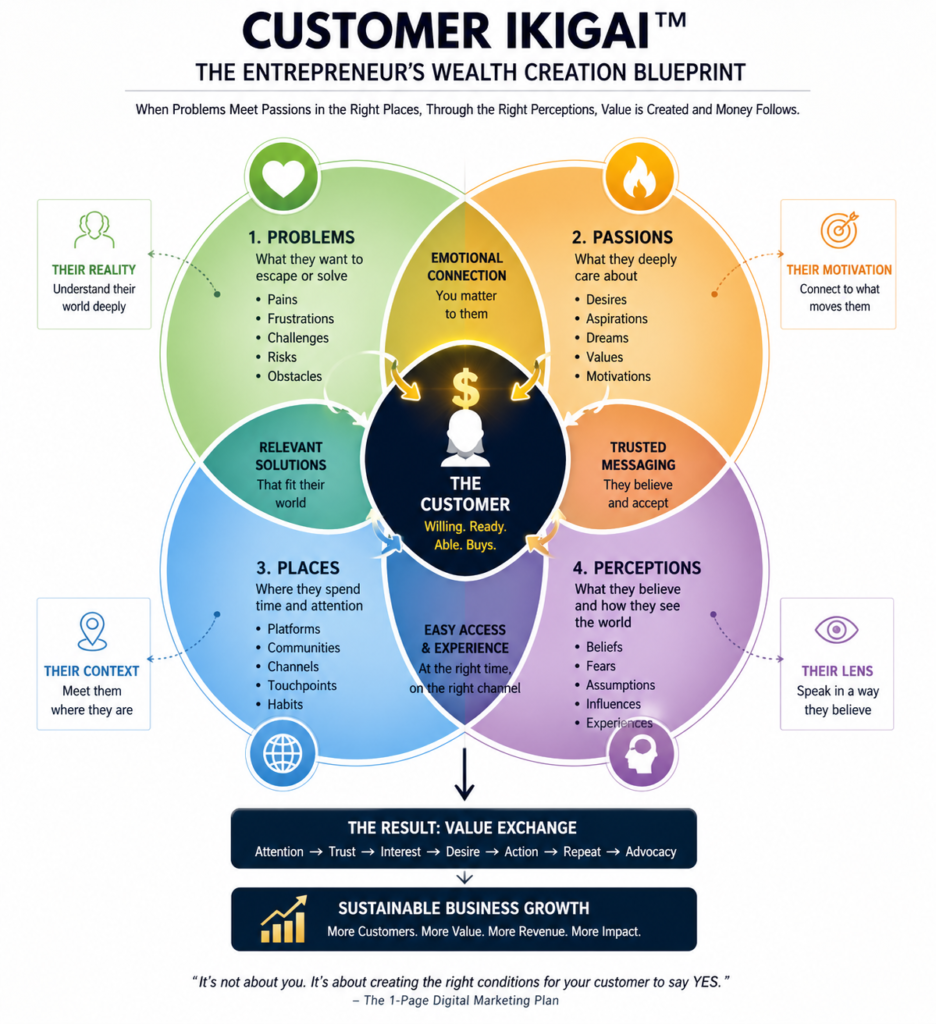
Customer Ikigai maps four dimensions of the specific human being you are trying to reach.
Problems. Not your product’s features in reverse. The actual, specific friction that wakes your customer at 2am and does not let them go back to sleep. The sentence they say to themselves when no marketer is listening. The shame they carry about the problem. The exhaustion of having tried solutions that did not work. The precise language of that frustration — because the language matters more than the diagnosis. Gallagher’s customers were not searching for “GLP-1 telehealth services.” They were searching for things like “why can’t I get Ozempic” and “is compounded semaglutide safe” and “how to get weight loss medication without a doctor’s appointment.” That language — the unpolished, unfiltered language of a real person with a real problem — is what he built his content, his product pages, and his conversion architecture around.
Passions. What your customer loves so deeply their financial logic breaks down. The identity they are constructing with every purchase. The version of themselves they are trying to become. Richard Thaler, the Nobel Prize-winning behavioural economist, proved that humans do not treat all money equally. There is an account for rent and an account for the things that make them feel alive. The passion account operates under completely different rules. Price sensitivity collapses. Comparison shopping stops. When your product taps the passion account — when it connects to an identity transformation the customer desires — you are no longer competing on price. You are operating in a different commercial category entirely.
Places. Where your customer tells the truth online. Not where you imagine they are. Where they actually are, at the exact moment they have the problem your product solves. Reddit at midnight. YouTube search bars at 6am. WhatsApp groups they trust more than any advertisement. Facebook communities where real people discuss real experiences in language that has never been filtered through a marketing brief. Paul Graham said: do things that do not scale at first. This is that work. Reading hundreds of comments. Mapping the exact words people use when they are frustrated, hopeful, sceptical, or finally ready to buy. That language is the most valuable marketing asset you can build. When you reflect it back in a headline or a subject line, something neurological happens: the customer’s brain registers this was written for me. And the sale is already half done.
Perceptions. What your customer already believes about businesses like yours before you say a word. This is the dimension most marketing ignores entirely — and pays for dearly. No campaign in history has successfully changed what a human being deeply believes. Every campaign that has ever worked did so by working with existing beliefs, not against them. Gallagher’s customers carried a specific perception about telehealth weight-loss services: they were sceptical of the legitimacy, afraid of the quality of compounded medication, uncertain whether the product would actually arrive, and worried about being sold something that looked medical but was not. He did not run ads telling them those fears were wrong. He built the entire product experience around dismantling those perceptions — fast delivery, transparent clinical oversight, genuine customer support, visible proof of legitimacy at every step. The product was the answer to the Perception. Not an ad. The product itself.
The most powerful intersection in Customer Ikigai is between Problems and Perceptions. Your customer has a problem and a belief — often a deeply sceptical one — about whether anyone in your category can solve it. The business that names the objection before the customer raises it, that says “I know you have been let down before, and here is specifically why this is different” — that business closes sales at a rate that a business focused only on features cannot approach.
Step Two: Simba’s Five Forces — understand the invisible game before you play it.
The internet is not a neutral distribution channel. It has five structural forces that determine whether your content reaches your customer or disappears without a trace, and understanding them before you commit to a content strategy is the difference between building intelligently and learning expensively.
New Content is the volume of posts, videos, images, and AI-generated material flooding your category every hour. In some niches, the noise floor is so high that producing average content is functionally equivalent to producing nothing. Substitute Content is the easier format competing for the same moment of your customer’s attention — the fifteen-second video that delivers the same insight as your three-thousand-word article, the meme that captures the same idea as your carefully constructed argument. If substitutes dominate your category, your content strategy must account for them or be replaced by them. Cognitive Rivalry means your competitor is not just the business selling the same thing — it is every comedian, news alert, sports score, and distraction living in the same feed as your content. Platform Power means TikTok, Meta, Google, and YouTube own the roads your customer travels on, and they change the rules without warning and without apology. User Power means every scroll, every skip, every save, every “Not Interested” tap is a vote the algorithm collects in real time. The audience is the algorithm. You do not beat the algorithm. You earn it, one user vote at a time.
Knowing these forces before you build a content operation tells you honestly what you are up against. Some categories require expensive video production to compete at all. Some platforms have algorithms so restrictive that organic reach is near zero. Some influencer ecosystems are so expensive that the cost of paid distribution destroys the unit economics. Better to know this on day one than to discover it nine months and ten thousand dollars later.
Step Three: Content/Market Fit — measure customers created, not views.
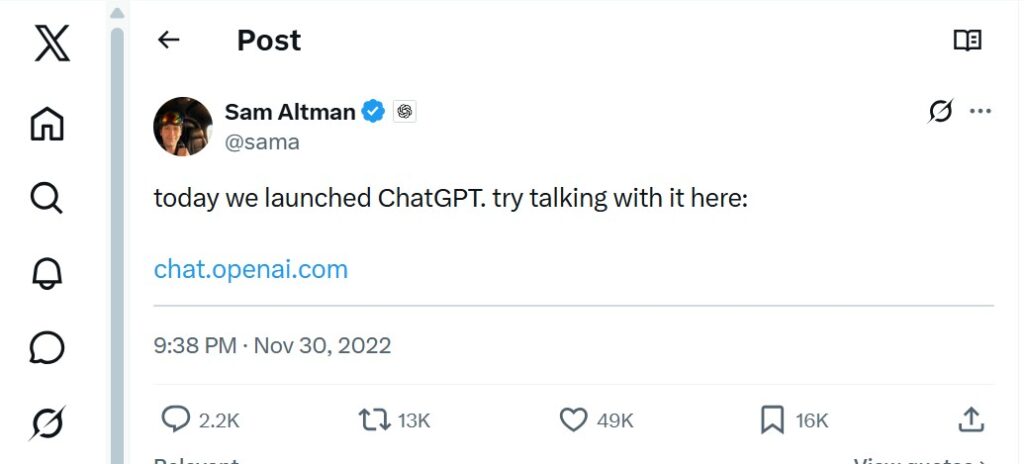
Sam Altman posted one tweet in November 2022 announcing that ChatGPT was live. Five days later: one million users. Two months later: one hundred million. The fastest consumer product adoption in recorded history. He was on Twitter — the platform with the highest concentration of technically curious, early-adopting, influential users in the world. He had a decade of institutional credibility from Y Combinator and OpenAI. The product was genuinely extraordinary. And the substitute for it was so inferior for the specific job being done that word of mouth was structurally inevitable. He did not go viral by accident. He deployed into the one environment on earth where that specific product would spread by its own force.
Elon Musk has used the same playbook — using existing platform presence, credibility, and an audience already primed for technical and cultural novelty to launch products and ideas at a velocity no paid campaign could match.
You probably do not have that position yet. Which means the system matters more, not less.
Listen to your customer using the Customer Ikigai research. Translate their language — their actual words, not your interpretation of their words — into content. Publish without paid amplification first, because you need to know whether the message works before you spend money making it louder. Track customers created — not views, not likes, not follower counts, not engagement rates. A post with ten thousand views and zero conversions is a public performance. A post with four hundred views and twelve paying customers is a machine. Build the machine.
Scale only what has already proven it creates customers without your money behind it. This is the sequence that cannot be shortcut: listen, translate, publish, track, scale. In that order. Every time.
Step Four: Internet Presence Optimisation — be everywhere your customer searches.
Your customer does not search in one place. They search on Google, YouTube, TikTok, Reddit, ChatGPT, Perplexity, Instagram, LinkedIn, WhatsApp communities, newsletters, and podcasts. If your business exists on one surface, it is invisible everywhere else — including the AI assistants that are now answering purchase-intent queries at scale, trained on the content that exists across those surfaces. The business invisible in those places is invisible to the machines that are increasingly making the first recommendations.
IPO is not “be everywhere” as a vague instruction. It is strategic presence — the same core message adapted for each platform’s format, culture, and expectation. A long-form essay on LinkedIn. A precise insight on TikTok. A genuine, non-promotional answer on Reddit. A personal note in a WhatsApp community. The message stays consistent. The execution changes for the surface. And the discipline is weekly — not quarterly, not when you remember, not when inspiration arrives. Weekly community contribution. Monthly review of owned channel growth. Quarterly audit of where your customers are moving and whether your presence is moving with them.
Step Five: Simba’s Content Matrix — measure ruthlessly and delete without sentiment.
The matrix classifies everything you publish into four categories. Stars have high engagement and create customers — scale them with paid amplification and produce more of them immediately. Catch-22s get attention but do not convert — they need a bridge from the interest they generate to commercial action, a next step that moves the engaged reader toward a decision. Evergreens may not spike, or go viral, or be sexy, but they convert consistently over months and years — protect them, replicate their structure, never delete them to make room for a trend. Zombies neither engage nor convert — delete them, regardless of the effort they cost, because every zombie you keep is cognitive debt on your understanding of what your Stars actually did differently.
Count conversions. Fix what does not convert. Build more of what does. Every other metric is a supporting actor. Conversion is the lead.
In the film Jerry Maguire, there is a scene where Tom Cruise’s character — a sports agent who has been fired, who has started over with one client and nothing else to operate from except conviction — delivers the line the entire film builds toward: “Help me help you.”
It is not a clever line. It is a desperate one. A man asking the one relationship he has left to give him a chance to prove that the system he believes in actually works.
That is entrepreneurship.
Not the Lamborghini or the Tesla with FSD pending since 2016. Not the passive income. Not the laptop on the beach. The moment you are down to one client, one chance, one month of runway, and you are still showing up — not because you have a guarantee that it will work, but because you have a system and a customer and a belief that if you understand the person on the other side of the screen deeply enough, and show up in the right places with the right message consistently enough, something will move.
Gallagher moved $401 million worth of value in his first year. Not because he was luckier than you. Not because he had access to AI tools and software you cannot reach. Because he understood his customer before he spent his money. Because he built a system before he built a content calendar. Because he measured conversions before he scaled spend his Meta Ads. Because he used AI to execute the strategy rather than to substitute for not having one.
The white-collar workers arriving at entrepreneurship from their AI-displaced roles will bring skills. Many of them are talented. Some have savings. But they have spent their careers operating inside someone else’s brand equity — carried by the company’s reputation, the company’s customer base, the company’s accumulated trust. They have never had to build that trust from zero. From minus.
You have. Or you are about to.
That experience — the minus-to-zero journey, the period of sustained invisible effort that precedes every meaningful compound — is not a disadvantage once you have lived through it. It is a graduate-level education in customer creation that no MBA, no corporate career, and no YouTube channel can replicate.
The system in The 1-Page Digital Marketing Plan does not eliminate that journey. Nothing does. But it makes the journey shorter. Less wasteful. Less likely to kill your belief in the business before the business has had time to become what you know it can be.
You are not one idea away. You are not one viral post away. You are one system away.
If you ever watched the film Margin Call (2011), in the boardroom scene, the CEO says there are 3-ways of making a living, ‘Be First, Be Smarter or Cheat’. He concludes that of the 3, it is a hell lot easier to just be FIRST. Be the first to buy the book today. Be the first to read it this weekend — it is a workbook, not a textbook. You can move through it in a single sitting. Build your Customer Ikigai before Sunday is over. By Monday morning you will have more genuine customer understanding than most businesses in your category have accumulated in their entire existence – and you would be first to reaching your customers before your competition does.. And you will know what to do next — not because someone told you to post more or run more ads or hire an agency, but because you did the work that makes every subsequent dollar and every subsequent piece of content aim at something real.
Visit 1-pagedigitalmarketingplan.com. The weekend starts today.
Come find the thinking first. Marketing Millionaires. Millionaires Podcast. Millionaires TV. The social profiles. Stay close until reading about the system is no longer enough and you need to use it.
But know this. Gallagher started in September 2024. By December that year he had 1,000 customers. By December 2025 he had 250,000 and a company worth more than most people will earn in a lifetime. Not because the wave carried him. Because he understood exactly who was riding the wave before it broke, what they feared, what they wanted, where they were looking, and what they needed to believe before they would trust him with their money.
Derek Redmond crossed the finish line. Not first. Not in the medals. Just finished. With his father’s arm around him. That is the standard. Not perfection. Not speed. Finish.
The system helps you finish.
Now go.