The offer is the close. But 97% of your market is not ready to be closed yet. One page. One system. The engine Hormozi never built — now built for you.
On April 13, 1970, at 9:08 in the evening, 200,000 miles from Earth, Astronaut Jack Swigert — played by Kevin Bacon in Ron Howard’s 1995 film Apollo 13 — picked up the radio and said the words that stopped an entire planet cold.
“Houston, we have a problem.”
The oxygen tank had exploded. The lunar module was losing power. Three human beings were suspended in the dark, with fourteen hours of battery life, no heat, and a carbon dioxide filter held together by a sock, a plastic bag, and a piece of cardboard.
NASA had spent $355 million — equivalent to over $2.7 billion today — to build the most precise, most expensive, most technically advanced spacecraft in human history.
The mission to land on the moon never happened. Some said it was a total failure.
But here is what the mission did achieve: it got the crew home. Against odds that should have been impossible. Through improvisation, ingenuity, and a ground crew that refused to accept the problem as the final answer.
The mission was called a “successful failure.” The most expensive near-miss in the history of human exploration.
I think about Apollo 13 every time an entrepreneur shows me their offer.
Because I see the same thing every week.
A product so well-built it deserves to be famous. A promise so sharp it should close immediately. A guarantee so generous it removes every possible objection.
And yet, zero sales.
The spacecraft is perfect. The mission never launched.
Let me be honest with you — the kind of honest I wish someone had been with me before I spent years learning this the painful way.
Most books that entrepreneurs are reading right now are giving you half the answer.
Half the answer sounds complete. That is the dangerous part.
Half a bridge gets you halfway across the river. Then you fall.
Alex Hormozi’s $100M Offers — and I say this as someone who respects the book enormously, who has read it carefully, who recommends it without hesitation — is one of the most important books written for entrepreneurs in the last decade.
It is also, by its own design, only half the answer to the questions you have about growing your business.
And that missing half is costing you money you cannot see leaving your business.
This essay exists to show you both halves. Not to replace $100M Offers. To complete the picture it started. By the end of this, you will understand exactly why your offer is not enough on its own — and what you need alongside it to make the whole machine run.
A Summary of $100M Offers — Because You Deserve the Full Picture
Before I tell you what $100M Offers does not cover, let me tell you what it covers brilliantly. If you have not read it, this is the summary. If you have, this is the framework you already believe in — articulated so we can build on it together.
The core argument of $100M Offers is this:
Most businesses do not have an offer. They have a product. Or a service. Or a thing they sell.
A product says: here is what I have.
An offer says: here is the transformation I guarantee, the risk I absorb, the bonuses I stack, the timeline I promise, and the price that makes refusing the offer make you feel stupid.
Hormozi introduces a concept he calls the Grand Slam Offer — an offer so compelling, so specific, so hard to compare against alternatives, that the right buyer thinks: I would be an idiot not to take this. Its similar to what Russell Brunson calls the Irresistible Offer.
He breaks it into four key components:
1. Dream Outcome. What does the buyer truly want? Not what your product does — what life looks like on the other side of buying it. Entrepreneurs who sell coaching programs do not sell coaching. They sell the feeling of predictable growth, of knowing what to do on Monday morning, of not lying awake at 2am wondering why nothing is working.
2. Perceived Likelihood of Achievement. Even if the outcome is real, the buyer must believe they can achieve it. Testimonials, case studies, guarantees, and credentials all do this job. Without perceived likelihood, even the best outcome sounds like a fantasy.
3. Time to Value. How fast does the buyer get the result? The shorter the time between buying and feeling the first win, the more valuable the offer becomes. “Results in 90 days” beats “results eventually.”
4. Effort and Sacrifice Required. The buyer does not want to work harder. They want the result with less effort than they have already been expending on the problem. The offer that promises transformation without adding burden is exponentially more attractive than the one that demands effort before delivering value.
Hormozi then shows you how to stack these components — adding bonuses, removing risk with guarantees, creating urgency through scarcity — until the offer reaches what he calls Grand Slam level: an offer so stacked that saying no feels uncomfortable.
This framework is real. It works. I have used elements of it. You should use elements of it.
Now. Here is where the conversation must go deeper.
The USP is Dead. Long Live the Offer.
Go to any grocery store. Walk to the bread aisle.
Count the bread products.
Not three. Not five. In a well-stocked supermarket, you will find twenty, thirty, sometimes forty different bread products. White. Brown. Seeded. Gluten-free. Sourdough. Artisan. Budget. Organic. Sliced. Unsliced. Half-loaf. Mega-loaf.
Every single one of them has a unique selling point. Different grain. Different process. Different promise.
Now: which one sells the most?
Not necessarily the best bread. The most distributed bread. The bread with the best shelf position, the most prominent packaging, the most recognisable brand, the most consistent presence in front of the person doing the shopping.
This is the world you are competing in.
Thirty years ago, you could build a business on a USP — a Unique Selling Proposition. A single point of difference that set you apart from two or three competitors. You were the faster one. The cheaper one. The local one. The more experienced one.
Today, whatever you sell, there are forty versions of it on the internet shelf. Every competitor has a USP. Most of them have guarantees. Many of them have testimonials.
So how do you stand out?
This is where Hormozi’s offer framework becomes genuinely powerful. Because the offer is not just a USP. The offer is a system of value — a constructed experience of buying that eliminates comparison and makes the price feel irrelevant.
But — and here is the thing the bread aisle teaches you that the book does not say — an incredible offer on a shelf nobody walks past is still an offer nobody buys.
The bread needs shelf position. Visibility. Distribution.
So does your offer.
The Words that Build the Offer: Copywriting & the Customer Ikigai
Here is a question most entrepreneurs never stop to ask:
How do you know which words to use when you create your offer?
Hormozi tells you the structure. But the words — the specific, precise, emotionally resonant words that make a stranger feel understood before they have given you a single penny — those come from somewhere deeper.
They come from knowing your customer the way a great doctor knows their patient.
Not demographics. Not “35-44 year old males interested in business and finance.”
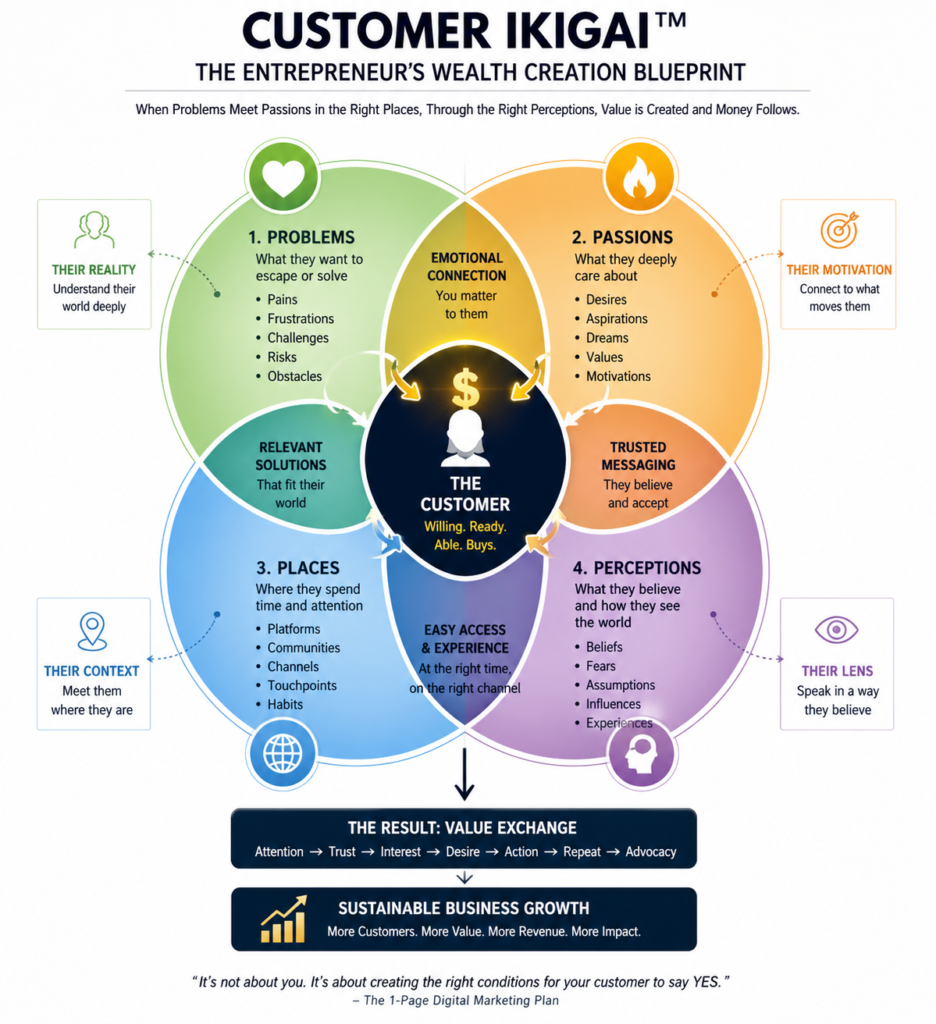
I am talking about something more precise. I call it Customer Ikigai — the intersection of four forces that define your customer as a full human being:
Their problems — the ones that keep them awake at 2am, the ones they have stopped admitting to friends because it is embarrassing to still not have fixed them.
Their passions — what makes them lean forward, what they obsess over, what identity they are trying to grow into.
Their places — where they actually consume content. YouTube. Reddit. TikTok. WhatsApp groups. Facebook. Not where you wish they were. Where they actually are at 7pm on a Tuesday.
Their perceptions — what they believe before they read a single word you have written.
When you know all four — when you sit at the intersection of what they desperately need, what they love, where they are, and what they already believe — the words for your offer literally and magically write themselves.
You are not persuading a stranger. You are confirming what they already suspected in their head.
The offer is not a pitch. At its best, the offer is a mirror.
The customer looks at it and thinks: this person understands exactly what I am dealing with.
That is the moment everything shifts.
And here is what this means for copywriting: you cannot write a great offer without first doing the customer ikigai work. You cannot write a headline that stops someone mid-scroll if you do not know what they fear losing. You cannot write a guarantee that removes objection if you do not know what burned them last time.
$100M Offers teaches you to build the structure of the offer. Customer Ikigai gives you the words to fill that structure with the right person’s truth.
Both matter. Neither works without the other.
The 97% Problem — And Why Your Offer Alone Cannot Solve It
Now. The number that changes everything.
At any given moment, research into buyer readiness established that only 3% of your market is actively ready to buy. These are the people with the problem fully acknowledged, the urgency felt, the budget available, the comparison already done. For these people, a grand slam offer works like a key in a lock. Click. Sale.
Another 7% are open. They are warming up. They are curious. They might buy if the right thing appeared at the right moment.
The remaining 90% are not in buying mode at all. Not because they are the wrong customer. Because they are not yet ready.
This is not a flaw in Hormozi’s framework. He designed it for the 3% and the warmer end of the 7%. He is explicit that offers require traffic — he says so in the book. And his follow-up, $100M Leads, addresses exactly this question.
But here is what I see happening in practice, with entrepreneurs across every market I have worked in — from London to Lagos, from Harare to Jakarta:
The entrepreneur reads $100M Offers. They build the offer. They feel the clarity, the sharpness, the confidence of having something genuinely good to sell.
Then they post it on the internet.
And they aim it at everyone.
The 3% who were ready never saw it — because there was no system to put the offer in front of them at the right moment.
The 7% who were warming up saw it too early — before they trusted the person behind the offer.
The 90% who were cold saw it and scrolled past — because nothing had ever told them they had the problem your offer solves.
The offer does not fail because it is weak.
The offer fails because it arrived without an engine to drive the right people toward it, at the right stage, with the right message.
The Tinder Problem — And Why Proposing on the First Date Never Works
Let me tell you something about Tinder, the dating app.
The entire premise of Tinder is that the first message matters. The profile matters. The picture matters. The opening line matters. Because you are a stranger, trying to earn the attention of another stranger, in a marketplace of strangers where everyone is also trying to do the same exact thing.
On Tinder, proposing marriage in the first message does not work. Its like shooting yourself in the foot.
Unless — and I say this only because the last conversation I ever had with my mother before she passed was about this exact subject, and she made me laugh harder than I had in years — unless you are the Tinder Swindler.
If you have not watched the Netflix documentary: a man named Simon Leviev used Tinder to meet women across Europe, constructed an elaborate fiction of wealth and danger, and persuaded multiple women to transfer him hundreds of thousands of dollars — before disappearing.
His “offer” was absurd. His “product” was fake. His guarantee was nonexistent.
But he had one thing that most honest entrepreneurs do not: a system.
He built trust first. He showed up consistently. He created an emotional connection before he asked for anything. He established credibility — fake credibility, but credibility — before he made his move.
I am not telling you to deceive anyone. I am telling you that even a con artist understood something most legitimate businesses miss:
The sale happens at the end of a journey. Not at the beginning.
Your customer needs to know you exist before they can consider you. They need to understand the problem you solve before they can want your solution. They need to trust you before they can believe your promise. They need to compare you favourably before they choose you.
The grand slam offer closes the journey.
It does not replace the journey.
And the entrepreneur who launches a beautiful offer at a cold audience — skipping the journey entirely — is doing the marketing equivalent of proposing on the first date.
The answer is almost always no. Not because the offer is bad. Because the timing is wrong.
The Race to the Bottom — Why “Just Run Ads” Is A Red Ocean Trap
Here is the painful reality nobody wants to say:
Just because you have a grand slam offer does not mean your competition will not also have a grand slam offer.
The moment a framework becomes popular — and $100M Offers is one of the most popular business books of the last five years — every serious entrepreneur in your market reads it, applies it, and builds their own version.
Now you have multiple grand slam offers competing for the same buyer on the internet, most probably on the same platform.
What decides who wins?
Marketing budget.
The competitor with the most marketing budget to hand over to Google or Meta gets their offer in front of the buyer first. The competitor who can afford to run retargeting campaigns gets seen eight, nine, ten times before you appear once. The competitor with a $50,000 monthly ad budget will always beat the competitor with a $500 monthly ad budget — even if the smaller competitor has the better offer.
This is not a blue ocean strategy. This is the definition of a red ocean: competing for the same customer’s attention through the same channels, with the same weapons, at the mercy of whoever has the deepest pockets.
For most entrepreneurs I know — building from nothing, with no safety net, often in markets where every dollar spent on ads is a dollar with real stakes — this is not a game you can win by playing it on their terms.
So what is the alternative?
Content.
Not random content. Not motivational quote content. Not “look at me” content. Not content to please Miss Attention.
A content engine — a deliberate system that moves different people through different stages of the journey, using different types of content matched to where each person currently sits.
Cold audiences need content that names their problem.
Warm audiences need content that builds trust.
Hot audiences need content that makes comparison easy — and makes your offer win that comparison.
This is what I call Internet Presence Optimization — IPO. The deliberate distribution of the right content, to the right audience stage, across the right platforms, measured against the right outcomes.
IPO is not posting. IPO is the invisible machine behind every offer that actually sells at scale.
Sam Altman’s 2026 offer — the ChatGPT Plus for free for a month push designed to win back users who had flocked to open-source alternatives and Claude — was not a tweet that worked because the tweet was clever.
The tweet worked because of what existed before the tweet.
ChatGPT is already popular. The product has millions of reviews on Apple and Google Play store.. YouTube is full of tutorials. TikTok has an entire subculture built around using it. Trust, recognition, and distribution were already built. The tweet was the final move in a game that had been running for years.
Your job is to build that invisible machine — the one that makes your offer’s final move land when it counts.
Content-Market Fit — The Term That Completes the Picture
You have heard of product-market fit. The moment your product clicks with the market that needs it.
You may have heard of offer-market fit. The moment your offer construction matches the desires of the buyer.
But there is a third term that most marketing books skip entirely — and it is the one that determines whether your engine actually runs.
Content-market fit.
The moment your audience encounters your content and thinks: this business understands exactly what I am dealing with.
Not impressed. Not informed. Understood.
That feeling — of being seen, of recognition — is the most powerful purchase trigger in existence. Because it does not feel like marketing. It feels like finding someone who gets it.
Content-market fit happens when:
- Your cold content names the problem so precisely that strangers feel called out
- Your warm content builds a framework so clearly that curious people start trusting your thinking
- Your hot content makes the comparison so obvious that the buyer reaches for your offer before you ask them to
Different content types. Different audience stages. One engine.
Some content should make cold people aware the problem is costing them. Some should make skeptical people believe your solution is real. Some should build the trust that makes your guarantee credible. Some should make the buyer compare you against the best alternative — and choose you.
The six conversion gaps — from Unaware, to Aware, to Curious, to Trusting, to Considering, to Buying — each require different content doing different jobs.
Most entrepreneurs build content for Gap Six. They leave the first five gaps completely unaddressed. Then they wonder why the offer is not closing.
The 1-Page Digital Marketing Plan — Where the Engine Lives
I wrote The 1-Page Digital Marketing Plan because I needed it and it did not exist.
Not for the entrepreneur with a team, a budget, and an agency on retainer. For the entrepreneur who is simultaneously the CEO, the content creator, the customer service rep, and the marketing department — who needs a system that is simple enough to actually use, and powerful enough to actually work.
The book gives you one page. Five frameworks. The questions you must answer before you spend a single minute creating content or a single pound on ads.
Who exactly is this for? What do they already believe before they encounter you? What problem are they aware of, and what problem do they not yet know they have? What content moves them from unaware to curious? What proof builds the trust that makes your guarantee land? What offer closes the journey you have already built?
It is not a course. It is not a 400-page theory exercise on marketing.
It is the marketing operating system (OS) for the serious entrepreneur who does not have time to get it wrong.
And it complements $100M Offers in a way that neither book covers alone.
Hormozi gives you the weapon. I give you the targeting system.
Hormozi shows you how to make the offer irresistible. I show you how to ensure the right person discovers it, understands it, trusts it, and arrives at it already half-convinced.
One builds the close. The other builds the journey before the close.
You need both.
The Dots, Connected
Let me revisit the story about Apollo 13.
NASA spent $355 million. The mission failed to land on the moon. But the crew came home — because the team on the ground refused to accept the problem as the final answer. They improvised. They built a CO2 filter from a sock and a plastic bag. They solved problems nobody had a manual for.
And here is what history remembers about Apollo 13:
Not the failure. The ingenuity.
Not what did not happen. What happened instead.
The mission that achieved nothing it set out to achieve became one of the greatest demonstrations of human problem-solving in history. It changed how NASA prepared for failure. It changed the protocols, the training, the redundancies.
The incomplete mission made every future mission better.
$100M Offers is your Apollo 13.
It launched. It got you further than most. It changed how you think about what you sell. And at a certain altitude — the altitude where you have the offer built and the silence is loudest — it told you: Houston, we have a problem.
The offer exists. The engine does not.
The 1-Page Digital Marketing Plan is the ground crew.
Not a replacement for the spacecraft. The team that gets the spacecraft — and the people inside it — home.
Here is what this essay has shown.
A product is not enough. It never was. The grocery aisle proved that thirty years ago.
A USP is not enough. Every competitor has one. The internet proved that a decade ago.
An offer — even a grand slam offer — is not enough. Because 97% of your market is not ready for the close. They are still somewhere on the journey. Unaware. Curious. Skeptical. Comparing.
The entrepreneur who wins does not only have the best offer.
They have the best offer and the engine that moves people toward it — one piece of content at a time, one conversion gap at a time, one trust-building moment at a time — until the offer closes what the engine already opened.
Read $100M Offers. Study it. Build the irresistible offer.
Then open The 1-Page Digital Marketing Plan. Build the engine.
Because the offer is what they buy. The engine is the reason they ever found you.
If you agree with me, the next move is straightforward: get $100M Offers by Alex Hormozi for the offer, and get The 1-Page Digital Marketing Plan written by me for the engine that distributes it. Both books also available on Amazon. Both fit in a single weekend. One weekend, two books, one complete marketing system.
If you are not sure where to start, begin with the FREE 1-Page Digital Marketing Plan Template — the one-page framework that forces you to answer the questions your marketing is currently ignoring. No email course. No funnel. One template, FREE, at 1-pagedigitalmarketingplan.com/template